

Popular Model
ABB IRB 2600 Robot Financing
Finance an ABB IRB 2600 industrial robot for your production cell. Flexible terms, B/C credit considered, application-only up to $400k, 1-2 week funding.
Start Review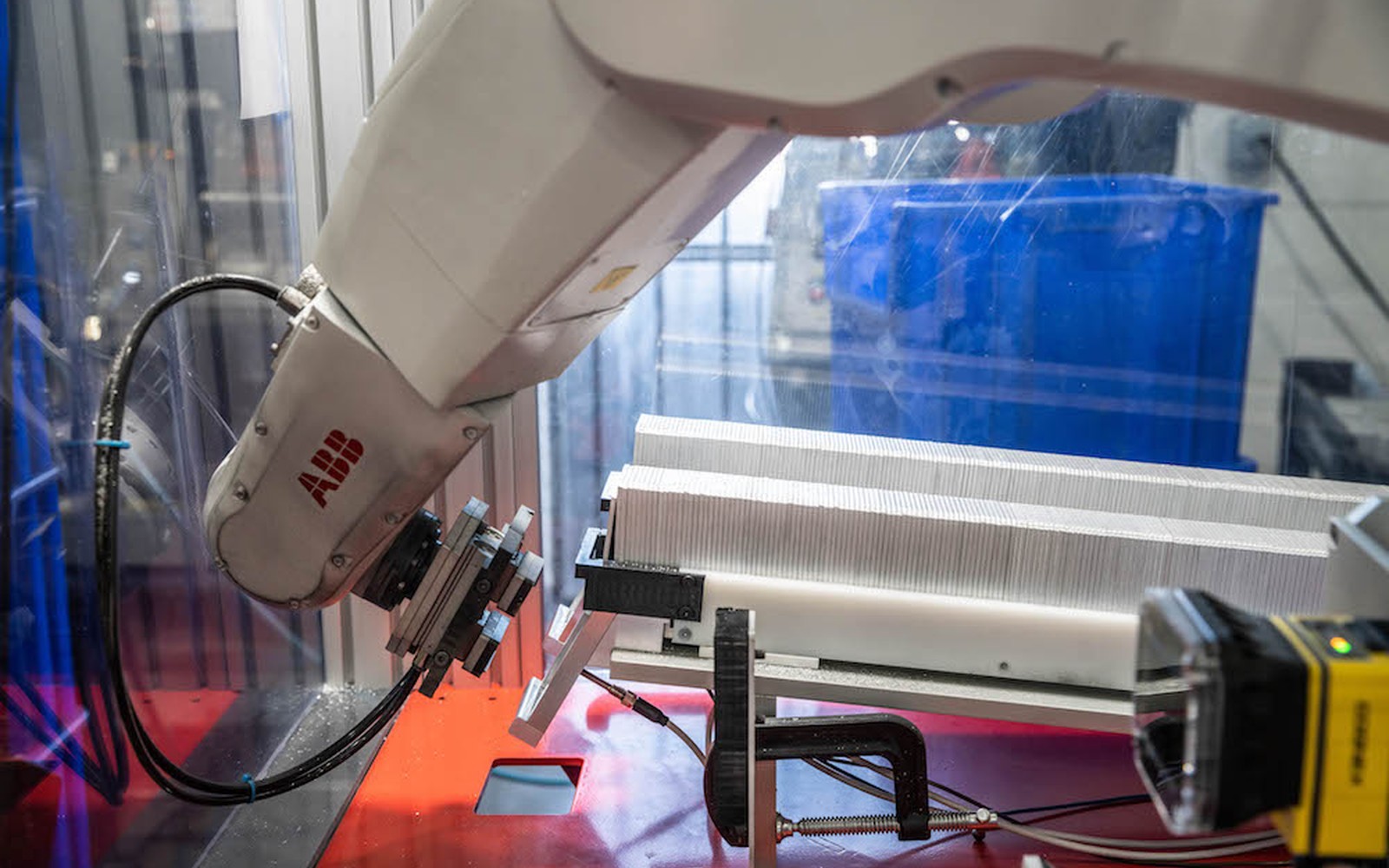
Compact footprint, 20 kg payload, and a wrist design oriented for arc welding and machine tending put the ABB IRB 2600 in a different part of the automation market than the heavier-frame robots that dominate press lines and body shops. The IRB 2600's reach configuration options (1,650 mm standard, 1,850 mm in the extended variant) allow the integrator to size the cell for the work envelope without overbuilding the structure. That constraint on cell size is an advantage in plants where floor space is the real scarcity.
We finance IRB 2600 cells for manufacturers, fabricators, and assembly operations across every industry that uses six-axis automation. Our minimum is $50,000, application-only approval runs to approximately $400,000, and funded deals close in about one to two weeks. Operators in Charlotte, NC and throughout the Southeast's expanding manufacturing base contact us for ABB robot financing because the credit speed we offer matches how quickly their integrators and program timelines expect commitments.
IRB 2600 Design Characteristics That Drive Its Market Value
ABB designed the IRB 2600 with a parallel upper-arm structure rather than the serial-link geometry used on most competing robots in the 20 kg class. That parallel arm carries the robot's internal cabling through the upper arm rather than on the exterior, which reduces cable fatigue failure on high-cycle arc welding or grinding applications and simplifies the arm's profile when operating near fixtures. The practical result is a longer mean time between cable replacements and a lower total maintenance cost over a five-year operating horizon, both of which matter when underwriting residual value.
The IRB 2600 is rated IP54 as standard with a wash-down option that brings it to IP67 for food or pharmaceutical applications. ABB's FlexArc welding cell packages pair the IRB 2600 with an ABB IRC5 controller, a ESAB or Lincoln welding power source, and purpose-designed welding tooling. A FlexArc cell as a complete unit is a strong collateral asset because the components are purpose-integrated and well-documented for secondary-market buyers.
Metal fabricators running MIG, TIG, or plasma arc processes are the core market for the IRB 2600 in arc welding configuration. For automotive Tier 1 and Tier 2 suppliers, the robot serves stamping press tending, part transfer, and spot weld or stud weld cells where a compact arm fits better than the larger S series or IRB 6700 family.
Credit Review and Documentation for ABB Robot Financing
Our credit review starts with the one-page application and the equipment quote from your ABB dealer, integrator, or seller. That is the full initial package for most transactions under $400,000. We do not open with a request for two years of tax returns or an outside appraisal. The robot, controller, tooling, and cell infrastructure are the collateral; their quality and secondary-market value inform the underwriting alongside the business's financial position.
Companies with B/C credit qualify more frequently than they expect on ABB robot financing because the IRB 2600 holds value well in secondary markets. A functional, late-model IRB 2600 cell is a liquid asset in the sense that integrators and manufacturers actively look for used ABB equipment. B/C credit equipment financing on well-collateralized robot cells is a practical path, not an exception.
Startups and younger businesses can also qualify when the contract or customer base supporting the production volume is clear. Startup equipment financing on automation is possible; the key variable is whether the business's future revenue is tied to a production commitment that the robot is being acquired to fulfill. OEM program letters, purchase orders, or committed capacity agreements all help the credit case.
Three months of bank statements completes the file for transactions above $400,000. We do not routinely require tax returns as a first step, though they may be requested on larger or more complex transactions.
Terms and Structures on IRB 2600 Financing
A complete IRB 2600 arc welding cell from a qualified ABB integrator typically runs $120,000 to $350,000 depending on the welding configuration, positioner included, and level of cell automation. Single-robot machine tending cells are often toward the lower end of that range; dual-robot welding stations with positioners and safety fencing push toward the top. All of those configurations fit within application-only approval territory for qualified operators.
Term lengths run 36 to 72 months on robot cell financing. Longer terms preserve working capital for production ramp costs; shorter terms reduce total interest but demand more monthly cash. Equipment leasing under an FMV structure reduces the monthly payment compared to a loan because the lease payment is sized against the expected residual rather than the full acquisition cost. For manufacturers who plan to upgrade the cell within five years, the FMV lease also provides a clean exit at end of term.
For operators who want ownership from day one and intend to depreciate the asset under Section 179, an equipment loan or dollar-buyout lease is the right vehicle. The robot and integrated cell components qualify as depreciable property, which makes the first-year tax treatment favorable when the acquisition lands before year end.
Questions About ABB IRB 2600 Robot Financing
Clear answers on equipment eligibility, documentation, timing, and transaction structure before you send the file.
Can I finance the ABB positioner and welding power source along with the robot?
Yes. A complete FlexArc or custom welding cell including the IRB 2600, IRC5 controller, positioner, welding power source, tooling, guarding, and integration is financed as a single transaction. The cell cost is the financed amount. You do not need separate loans for each component.
My arc welding cell will be installed in phases over three months. How does disbursement work?
We can structure milestone draws that fund each phase as it is completed and verified. Phase-one funds go to the integrator on robot delivery; phase-two funds release on cell completion. The structure matches your cash flow to the actual installation schedule rather than requiring full funding at contract signing.
We already own an older ABB robot. Can we trade in its value toward the IRB 2600?
Trade-in credit is handled between you and the dealer or integrator. If you sell the old robot privately, we can sometimes structure the proceeds as a down payment on the new cell. A sale-leaseback on the older unit is another option if it still has value and is generating production output.
Is an IRB 2600 we bought from an overseas liquidation eligible?
Import documentation, customs clearance, and a US-based condition assessment are required for robots sourced internationally. With those in hand, a foreign-sourced IRB 2600 can qualify. We look at the unit's current condition, its serviceability through ABB's North American parts network, and the total landed cost.
Our company has been operating for eighteen months. Is that enough history?
Eighteen months is workable, particularly when you have clear revenue and the robot is going to fulfill a defined production commitment. We look at cash flow, the nature of the business, and the contract or customer base. Some lenders want two years of history as a hard floor; we do not treat it that way.
Finance Your ABB IRB 2600 Robot Financing
Send the equipment quote, seller details, price, deposit, and delivery schedule. The financing desk will review the file and return a practical next step.